


Pass Your Exam Easily! D-VXR-DY-01 Real Question Answers Updated on Sep 16, 2026
Actual Questions Answers Pass With Real D-VXR-DY-01 Exam Dumps
NEW QUESTION # 106
A VxRail Manager VM must be configured as follows:
- IP address: 192 168.10.16
- Net mask: 255.255.255.0
- Gateway: 192 168 10 254
Which command must be used?
- A. vxrail-prrmary -config -ip 192 168 10 16 -netmask 255 255 255 0 -gateway 192 168 10 254
- B. vxrail-network-config -ip 192 168 10.16-netmask 255.255.255.0-gateway 192 168 10.254
- C. vxrail-network -config -vxrail-address 192.166 10 16 -vxrail-netmask 255 255.255 0 - vxrail-gateway 192.168.10.254
- D. vxrail-primary -config -vxrail-address 192.168.10 16 -vxrail-netmask 255 255 255 0 - vxrail-gateway 192.168,10 254
Answer: D
NEW QUESTION # 107
Which command will create a daily local backup of the VxRail Manager configuration and important log files?
- A. python /etc/vmware/backup_config/vxm_backup_restore.py -b --period daily --keeplog
- B. python /mystic/vxm_backup_restore/vxm_backup_restore.py -c --period daily --keeplog
- C. python /tmp/backup/vxm_backup_restore/vxm_backup_restore.py -c --period daily --keeplog
- D. python /mystic/vxm_backup_restore/vxm_backup_restore.py -b --period daily --keeplog
Answer: B
NEW QUESTION # 108
The default permissions of the vCenter server administrator account have been identified as a security concern. Due to this security issue, the customer cannot use the default administrator account for the VxRail deployment. What should the customer do to eliminate the concern?
- A. Create a custom role with full permissions. Add [email protected] to the new role.
- B. Create a custom role with limited permissions. Add [email protected] to the new role.
- C. Create a custom role with full permissions. Create a user and assign the new role.
- D. Create a custom role with limited permissions. Create a user and assign the new role.
Answer: D
Explanation:
Enterprise security standards often restrict the use of default administrative credentials, such as [email protected], due to auditing, accountability, and least-privilege enforcement policies. When preparing for a VxRail deployment with an external, customer-managed vCenter, it is not mandatory to utilize the unrestricted default administrator account. To eliminate security vulnerabilities while facilitating proper cluster initialization, the customer should create a custom role within vCenter configured with limited permissions, then provision a dedicated user account and assign it to this new role.
Dell specifies a precise, restricted matrix of privileges required by the VxRail Manager service account to manage host attachment, storage provisioning, network alignment, and lifecycle updates. By building a custom role that contains only these mandatory minimum privileges and binding it to a newly created non- default service user, the organization enforces a secure operational boundary. Modifying the permissions of the default [email protected] account or providing full administrative scope to a new user fails to satisfy least-privilege security requirements and can inadvertently destabilize global vCenter management operations.
References: Dell VxRail Deploy Study Guide; vCenter Server Choice and Planning; Security Roles and Privileges Configuration.
NEW QUESTION # 109
What is a characteristic of vSAN Erasure Coding?
- A. Is a DoD certified individual drive cleaning tool to facilitate drive replacement
- B. Used for Garbage Collection on all-flash VxRail clusters
- C. Is a Raid 5/6-like storage policy
- D. Used to securely erase vSAN storage to facilitate node replacement
Answer: C
NEW QUESTION # 110
Refer to the exhibit.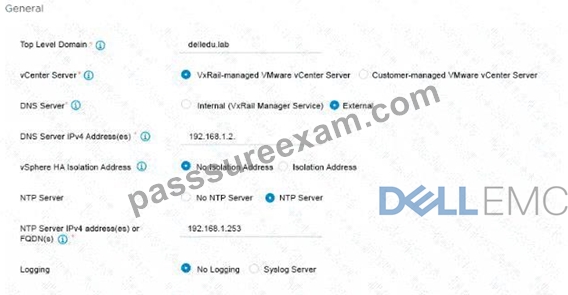
Which component is included in future VxRail Manager updates when the deployment of a VxRail Cluster is completed using the Global Settings shown?
- A. NTP Server
- B. vCenter Server
- C. DNS Server
- D. Windows Server
Answer: B
Explanation:
The exhibit illustrates the "General" settings section within the VxRail Deployment Wizard, where foundational infrastructure parameters are defined. Crucially, the radio button for "VxRail-managed VMware vCenter Server" is explicitly selected. In a VxRail deployment topology, choosing an internal, VxRail- managed vCenter server fundamentally changes how lifecycle management (LCM) operations are orchestrated for the cluster.
When a cluster is deployed with a VxRail-managed vCenter, the vCenter Server virtual appliance is tightly coupled with the VxRail Manager platform. This deep architectural integration guarantees that all future patch cycles, security definitions, and major platform upgrades for the vCenter Server are natively included within the unified VxRail composite update bundles. When an administrator applies an update package through the VxRail Manager dashboard, the orchestration engine automatically conducts pre-checks and applies the software versions to both the VxRail Manager and the vCenter Server in a fully automated, validated sequence. Conversely, infrastructure services configured as "External," such as the designated DNS or NTP servers, reside outside the VxRail ecosystem and are not targeted by VxRail lifecycle payloads. Therefore, the vCenter Server is the specific component captured in future update packages.
References: Dell VxRail Deploy Study Guide; VxRail Deployment Wizard Configurations; Lifecycle Management and Component Bundles.
NEW QUESTION # 111
What is the complete list of menu option choices available in the RASR factory reset procedure when booting from the RASR ISO?
- A. - RASR RESET
- CREATE RASRUSB
- FACTORY RESET
- QUIT - B. - RASR RESET
- CREATE RASRUSB
- FACTORY RESET
- REBOOT
- UPDATE FIRMWARE
- QUIT - C. - RASR RESET
- CREATE RASRUSB
- FACTORY RESET
- REBOOT
- UPDATE FIRMWARE
- EXIT - D. - RASR RESET
- CREATE RASRUSB
- FACTORY RESET
- UPDATE FIRMWARE
- EXIT
Answer: A
NEW QUESTION # 112
Which two types of key provider are supported in vSAN ESA using a VxRail-managed vCenter Server?
(Choose two.)
- A. Standard Key Provider with TPM 1.2 protected hosts
- B. Native Key Provider with TPM 1.2 protected hosts
- C. Standard Key Provider
- D. Native Key Provider
Answer: C,D
Explanation:
When deploying VMware vSAN Express Storage Architecture (ESA) within a Dell VxRail cluster environment managed by an internal, VxRail-managed vCenter Server, enforcing data security through cryptographic measures is fully supported. To enable vSAN Data-at-Rest Encryption, the platform requires an active key management infrastructure to handle keys securely. The architecture supports two primary types of key providers: the Native Key Provider (NKP) and the Standard Key Provider.
The Native Key Provider is an embedded, software-defined feature within vSphere that generates and manages keys internally, eliminating the requirement to deploy or license an external, third-party Key Management Server (KMS) system. The Standard Key Provider allows the internal vCenter Server to securely interface with external, KMIP-compliant enterprise Key Management Servers to manage key distribution.
Options mentioning Trusted Platform Module (TPM) 1.2 are invalid because modern vSAN ESA implementations demand advanced cryptographic sealing mechanisms that strictly require TPM 2.0 on the host hardware if hardware-backed protection is layered over the key provider architecture; TPM 1.2 fails validation checks.
References: Dell VxRail Deploy Study Guide; vSAN ESA Security and Encryption; Key Provider Configuration and Management.
NEW QUESTION # 113
What is a difference between vSAN Data-In-Transit Encryption and vSAN Data-At-Rest-Encryption?
- A. Data-In-Transit Encryption: Addresses fear of media theft Data-At-Rest Encryption: Addresses fear of rogue administrators
- B. Data-In-Transit Encryption: Key Management Server must reside on the vSAN cluster Data-At-Rest Encryption: Key Management Server can reside on the vSAN cluster
- C. Data-In-Transit Encryption: Does not require a Key Management ServerData-At-Rest Encryption: Requires a Key Management Server
- D. Data-In-Transit Encryption: Encrypts traffic between VMs and the VxRail nodesData-At-Rest Encryption: Encrypts traffic between VxRail nodes only
Answer: C
NEW QUESTION # 114
A company has multiple VxRail systems installed at geographically dispersed data centers They want to upgrade all their VxRail systems to the latest release- Before the upgrade, they want an inventory report of all the VxRail systems which shows the current health status and versions of all installed VxRail components.
What should be used to meet these requirements?
- A. Mitrend
VxRail Log insight - B. VxRail Plugin for vCenter Server
DRM Services - C. VxRail Plugin for vCenter Server
VxRail API - D. itrend
Live Optics
Answer: A
NEW QUESTION # 115
What are the minimum requirements for a customer-supplied VDS in a VxRail deployment?
- A. 4 uplinks
Port groups for Discovery, Management, vMotion, and vSAN only - B. 2 uplinks
Port groups for Discovery, Management, vCenter Server, vMotion, and vSAN - C. 4 uplinks
Port groups for Discovery, Management, vCenter Server, vMotion, and vSAN - D. 2 uplinks
Port groups for Discovery, Management, vMotion, and vSAN
Answer: B
NEW QUESTION # 116
Which vSAN license includes entitlement for vROps 8 Advanced Services?
- A. Enterprise
- B. Enterprise Plus
- C. Advanced
- D. Standard
Answer: B
NEW QUESTION # 117
An implementation engineer is tasked with expanding an 8-node VxRail E560 cluster with an S570 node. The cluster has been configured with 1 GbE networking.
Which two should be considered when planning to expand the cluster? (Select 2)
- A. AMD and Intel based nodes cannot be mixed
- B. Node limit has been reached on the cluster
- C. All nodes in the cluster must be the identical series
- D. E Series nodes require more capacity before expansion
Answer: A,B
NEW QUESTION # 118
When validating the VxRail health just after the VxRail initial configuration, there is a red exclamation mark on the MARVIN-Virtual-SAN-Cluster and the reported health alarm is 'Component metadata health'.
A "Retest" action in the health service panel is performed and all the nodes in the cluster show health status as failed with the invalid state. Investigation does not reveal any hardware issues with the disks in use by vSAN.
What action should be taken next?
- A. Reapply the MARVIN storage policy to the VxRail internal virtual machines
- B. Wait 24 hours, then click the "Retest" button again
- C. Evacuate and destroy the disk/disk group that contains the component(s) reporting errors and clear the alarm
- D. Apply the vSphere ESXi600-201611001 patch, then click the "Retest" button again
Answer: D
NEW QUESTION # 119
A VxRail API request has been performed, and the user account does not have vCenter privileges to perform the task. What code is returned?
- A. 0
- B. 1
- C. 2
- D. 3
- E. 4
Answer: A
Explanation:
The VxRail REST API uses standard HTTP status code conventions to communicate the outcome of programmatic management commands. When a REST API request is submitted to the VxRail Manager appliance, the request undergoes a strict authorization verification step against the vCenter Server Single Sign- On (SSO) and Role-Based Access Control (RBAC) frameworks to ensure the calling entity possesses the required privileges.
If the user account successfully completes authentication (proving identity) but lacks the specific administrative permissions within vCenter to execute that particular infrastructure task-such as adding a node or altering cluster network properties-the VxRail API gateway intercepts the operation and returns an HTTP status code 403 Forbidden. This response signifies that while the server understands who the user is, the account does not possess the structural clearance or functional rights to execute the requested payload. In contrast, an HTTP 401 Unauthorized status is returned if the request fails authentication completely due to invalid or missing credentials. Status code 500 signifies a general internal server error, making 403 the definitive response for privilege omissions.
References: Dell VxRail Deploy Study Guide; VxRail REST API Security Architecture; HTTP Status Codes and Error Handling.
NEW QUESTION # 120
In which VxRail model is the IDRAC NIC Selection Setting set to LOM1?
- A. S570
- B. G560
- C. E560
- D. G410
Answer: B
NEW QUESTION # 121
In which three VxRail Configuration Portal locations can an implementation engineer download the cluster configuration file? (Select 3)
- A. From the Resources tab in the Edit Cluster Configuration wizard
- B. From the Validate Configuration File tab when editing a cluster
- C. From the My Deployments tab in the VxRail Configuration Portal
- D. From the customer Dell Digital Locker website
- E. From the My Clusters Tab in the VxRail Configuration Portal
Answer: B,C,E
NEW QUESTION # 122
When resetting a Dell PowerEdge-based VxRail node to an existing factory image, which boot device should be selected?
- A. BOSS
- B. SATADOM
- C. RASRUSB
- D. IDSDM
Answer: D
NEW QUESTION # 123
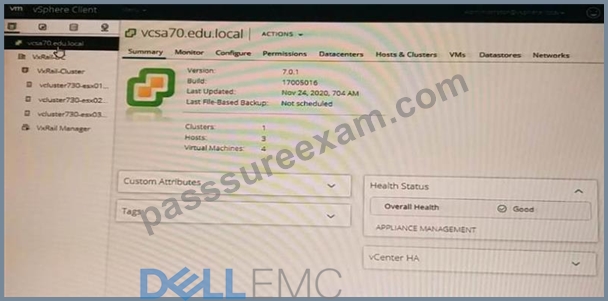
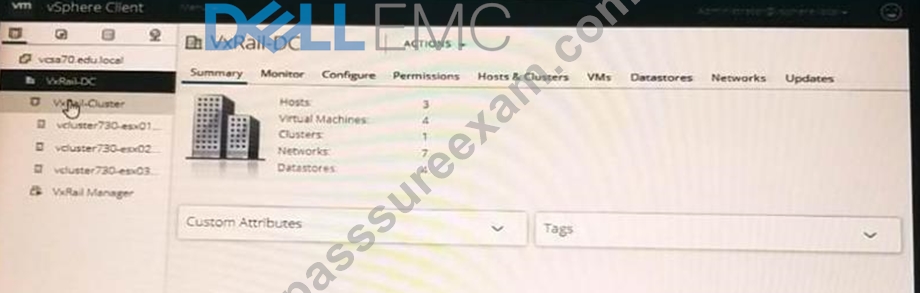
A VxRail Cluster has just been deployed. Use the VxRail simulator to determine the Service Tag, Model, and ESXJ IP Address of the first node - vcluster730.esx01.edu.local. Note: It is necessary to dose (x) the simulator window before you can select a response to this question.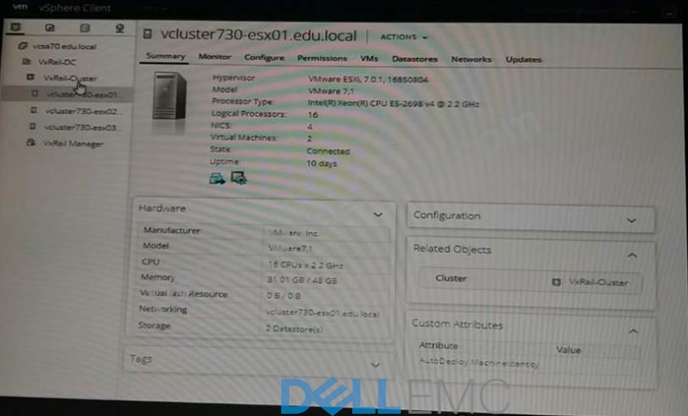
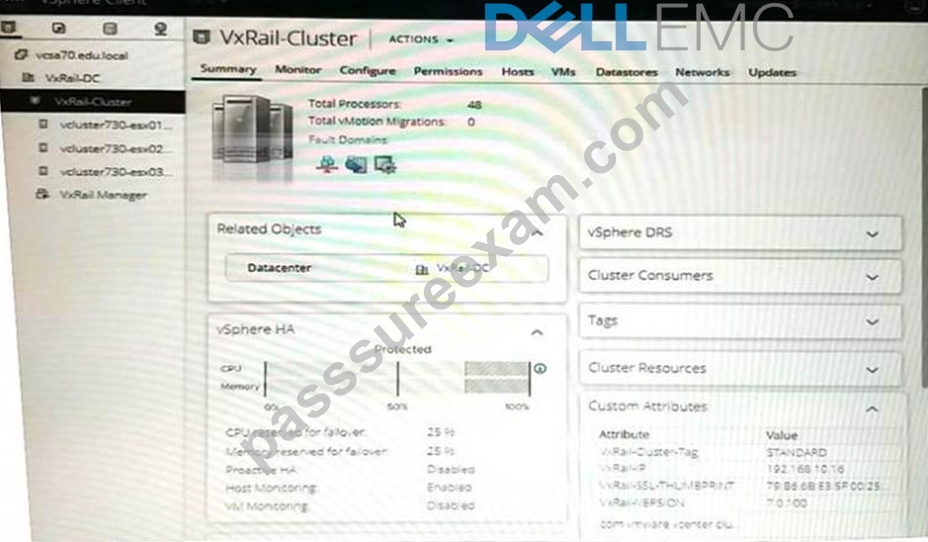
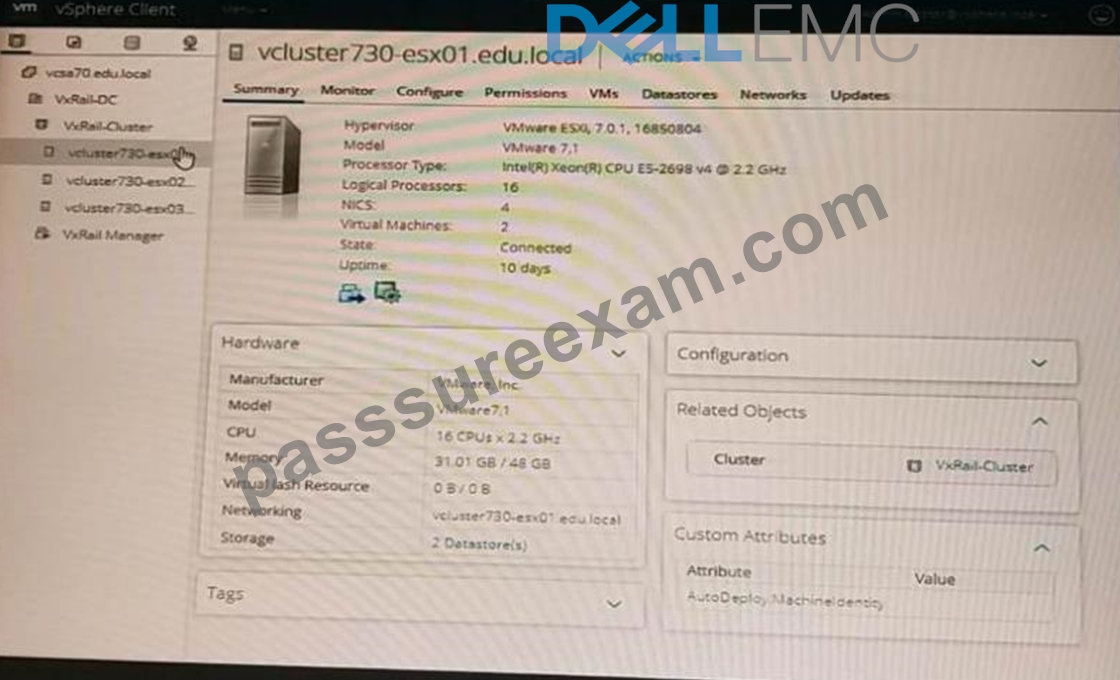
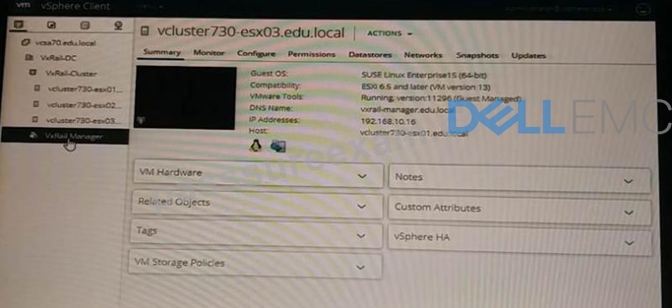
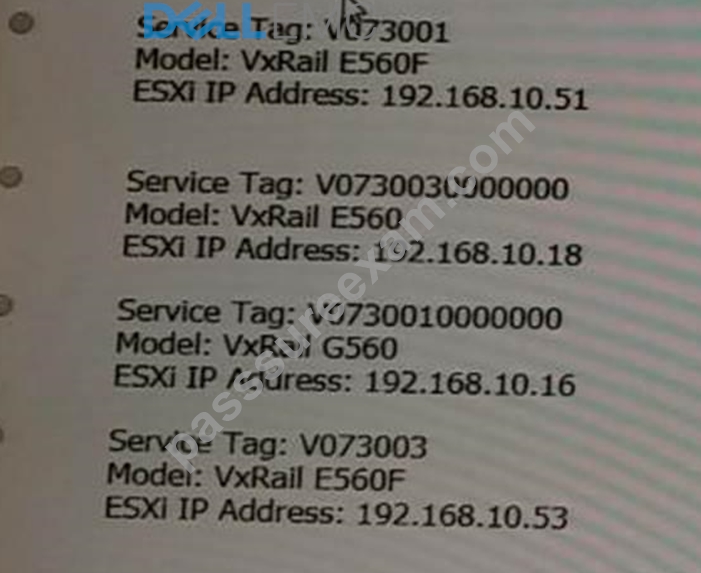
- A. Option C
- B. Option B
- C. Option A
- D. Option D
Answer: D
NEW QUESTION # 124
In a VxRail Stretched Cluster built from eight all-flash nodes, what should be the recommended storage policy to ensure the highest possible protection?
- A. Raid-5/6(Erasure Coding) FTT=1
- B. Raid-1(Mirroring) FTT=1
- C. Raid-1(Mirroring) FTT=2
- D. Raid-5/6(Erasure Coding) FTT=2
Answer: A
NEW QUESTION # 125
Match each VxRail configuration with its related characteristic.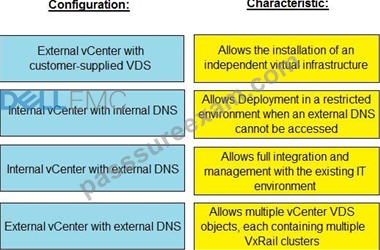
Answer:
Explanation: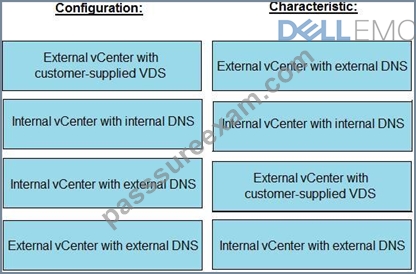
NEW QUESTION # 126
A VxRail Test Plan has been completed.
What is the protocol for recording the results?
- A. In front of a customer, complete each test and document the test date
- B. With the implementation team, complete each test and document the test date
- C. With the implementation team, complete and document each test, test date, and a screenshot of results
- D. In front of a customer, complete and document each test, test date, and a screenshot of results
Answer: C
NEW QUESTION # 127
......
New D-VXR-DY-01 Dumps - Real EMC Exam Questions: https://passleader.passsureexam.com/D-VXR-DY-01-pass4sure-exam-dumps.html