


The Best Practice Test Preparation for the CPC Certification Exam
CPC Exam Dumps, Practice Test Questions BUNDLE PACK
NEW QUESTION # 102
A 42-year-old with chronic left trochanteric bursitis is scheduled to receive an injection at the Pain Clinic. A 22-gauge spinal needle is introduced into the trochanteric bursa under ultrasonic guidance, and a total volume of 8 cc of normal saline and 40 mg of Kenalog was injected.
What CPT code should be reported for the surgical procedure?
- A. 20610-LT, 76942
- B. 20611-LT
- C. 20611-LT, 76942
- D. 20610-LT
Answer: B
NEW QUESTION # 103
A patient had surgery a year ago to repair two flexor tendons in his forearm. He is in surgery for a secondary repair for the same two tendons.
Which CPT coding is reported?
- A. 0
- B. 25272 x 2
- C. 25263 x 2
- D. 1
Answer: C
NEW QUESTION # 104
Preoperative diagnosis: Right thigh benign congenital hairy nevus. *1
Postoperative diagnosis: Right thigh benign congenital hairy 0 nevus.
Operation performed: Excision of right thigh benign congenital>1
nevus, excision size with margins 4.5 cm and closure size 5 cm.
Anesthesia: General.0
Intraoperative antibiotics: Ancef.0
Indications: The patient is a 5-year-old girl who presented with her parents for evaluation of her right thigh congenital nevus. It has been followed by pediatrics and thought to have changed over the past year. Family requested excision. They understood the risks involved, which included but were not limited to risks of general anesthesia, infection, bleeding, wound dehiscence, and poor scar formation. They understood the scar would likely widen as the child grows because of the location of it and because of the age of the patient. They consented to proceed.
Description of procedure: The patient was seen preoperatively in > I the holding area, identified, and then brought to the operating room. Once adequate general anesthesia had been induced, the patient's right thigh was prepped and draped in standard surgical fashion. An elliptical excision measuring 6 x 1.8 cm had been marked. This was injected with Lidocaine with epinephrine, total of 6 cc of 1% with 1:100,000. After an adequate amount of time, a #15 blade was used to sharply excise this full thickness.
This was passed to pathology for review. The wound required limited undermining in the deep subcutaneous plane on both sides for approximately 1.5 cm in order to allow mobilization of the skin for closure. The skin was then closed in a layered fashion using 3-0 Vicryl on the dermis and then 4-0 Monocryl running subcuticular in the skin, the wound was cleaned and dressed with Dermabond and Steri-Strips.
The patient was then cleaned and turned over to anesthesia for S extubation.
She was extubated successfully in the operating room and taken S to the recovery room in stable condition. There were no complications.
What CPT codes are reported?
- A. 37184-RT, 75716-26
- B. 35875-RT, 75710-26
- C. 35875-RT, 75716-26
- D. 35876-RT, 75710-26
Answer: B
Explanation:
35875 = Thrombectomy, femoral-popliteal artery
RT = Right side
75710-26 = Angiography, extremity, unilateral, professional component
NEW QUESTION # 105
A patient is taken to the radiology department for a radiological cardiac catheterization. An acute MI of the left anterior descending coronary artery is found. The cardiologist performs a suction thrombectomy, followed by atherectomy and a stent to the artery. A CRNA provides MAC for this patient, who is status P5.
What code/modifier combination would you report for the services of the CRNA?
- A. 00520-QX-QS-P5
- B. 01925-QZ-P5
- C. 01925-QZ-QS-P5
- D. 00520-QZ-P5
Answer: A
Explanation:
The patient is undergoing a cardiac catheterization with a CRNA providing monitored anesthesia care (MAC).
Code 00520 is for anesthesia for heart catheterization procedures. Modifier QX indicates CRNA service with medical direction by a physician, QS indicates MAC, and P5 indicates a patient with a severe systemic disease that is a constant threat to life. Thus, the correct code and modifier combination is 00520-QX-QS-P5.
References: CPTProfessional Edition (current year), AMA.
NEW QUESTION # 106
A woman who is 19 weeks pregnant is taken to the hospital from her doctor's office due to the detection of no fetal heartbeat and the death of the fetus. Due to the stage of pregnancy, labor is initiated, and the fetus is delivered.
What CPT and ICD-10-CM codes are reported for the delivery of the fetus on the maternal record?
- A. 59820, 002.1. Z3A.19
- B. 59821, O36.4XX0, Z3A.19
- C. 59820, O36.4XX0
- D. 59821,002.1
Answer: B
Explanation:
Procedure Coding (CPT):
59821 - Induced abortion, by vaginal suppository, amniotic fluid injection, or other medical means Used for fetal demise at ≥14 weeks gestation Labor was medically induced and fetus delivered Diagnosis Coding (ICD-10-CM):
O36.4XX0 - Maternal care for intrauterine death, not applicable or unspecified Correct maternal record diagnosis Z3A.19 - 19 weeks gestation Required per ICD-10-CM guidelines for obstetric encounters Why Other Options Are Incorrect:
A / D - ICD-9 code (002.1) is invalid
C - Missing required gestational age code
NEW QUESTION # 107
View MR 001394
MR 001394
Operative Report
Procedure: Excision of 11 cm back lesion with rotation flap repair.
Preoperative Diagnosis: Basal cell carcinoma
Postoperative Diagnosis: Same
Anesthesia: 1% Xylocaine solution with epinephrine warmed and buffered and injected slowly through a 30- gauge needle for the patient's comfort.
Location: Back
Size of Excision: 11 cm
Estimated Blood Loss: Minimal
Complications: None
Specimen: Sent to the lab in saline for frozen section margin control.
Procedure: The patient was taken to our surgical suite, placed in a comfortable position, prepped and draped, and locally anesthetized in the usual sterile fashion. A #15 scalpel blade was used to excise the basal cell carcinoma plus a margin of normal skin in a circular fashion in the natural relaxed skin tension lines as much as possible The lesion was removed full thickness including epidermis, dermis, and partial thickness subcutaneous tissues. The wound was then spot electro desiccated for hemorrhage control. The specimen was sent to the lab on saline for frozen section.
Rotation flap repair of defect created by foil thickness frozen section excision of basal cell carcinoma of the back. We were able to devise a 12 sq cm flap and advance it using rotation flap closure technique. This will prevent infection, dehiscence, and help reconstruct the area to approximate the situation as it was prior to surgical excision diminishing the risk of significant pain and distortion of the anatomy in the area. This was advanced medially to close the defect with 5 0 Vicryl and 6-0 Prolene stitches.
What CPT coding is reported for this case?
- A. 0
- B. 1
- C. 14001, 11606-51, 12034-51
- D. 14001, 11606-51
Answer: D
Explanation:
For the excision of an 11 cm lesion with a rotation flap repair, the appropriate CPT codes are 14001 for the adjacent tissue transfer or rearrangement (12 sq cm flap) and 11606-51 for the excision of a malignant lesion including margins, face, ears, eyelids, nose, lips; excised diameter over 4.0 cm. Modifier 51 indicates multiple procedures. The detailed operative report specifies the lesion size and the technique used, justifying these codes.
References: CPT Professional Edition (current year), AMA.
NEW QUESTION # 108
A 13-year-old established patient is seen for an annual preventive exam. Last visit was two years ago.
What CPT code is reported?
- A. 0
- B. 1
- C. 2
- D. 3
Answer: D
Explanation:
99393 = Preventive visit, established patient, age 5-11
Preventive codes are based on age and patient status, not time since last visit
NEW QUESTION # 109
A 4-week-old premature infant receives a 100 mg IM injection of RSV monoclonal antibody.
What CPT codes are reported?
- A. 90380 ×2, 96369
- B. 90378 ×2, 90471
- C. 90378 ×2, 96372
- D. 90380 ×2, 90460
Answer: C
Explanation:
90378 = RSV monoclonal antibody, 50 mg per dose
100 mg = 2 units
96372 = Therapeutic IM injection
Vaccine admin codes (90460/90471) do not apply
NEW QUESTION # 110
A surgeon removes the right and left fallopian tubes and the left ovary via an abdominal incision. How is this reported?
- A. 0
- B. 58720-50
- C. 58700-50
- D. 1
Answer: D
Explanation:
* Bilateral salpingo-oophorectomy: This involves the removal of both fallopian tubes and ovaries.
* Right and left fallopian tubes: Both fallopian tubes are removed.
* Left ovary: Only the left ovary is removed.
* Abdominal incision: The procedure is performed via an abdominal approach.
* 58720: Salpingo-oophorectomy, complete or partial, unilateral or bilateral (separate procedure).
The procedure involves the removal of both fallopian tubes and one ovary, making 58720 the appropriate code.
References:
* AMA's CPT Professional Edition (current year)
* ICD-10-CM (current year), HCPCS Level II (current year)
NEW QUESTION # 111
The surgeon performs Roux-en-Y anastomosis of the extrahepatic biliary duct to the gastrointestinal tract on a
45-year-old patient.
What CPT code is reported?
- A. 0
- B. 1
- C. 2
- D. 3
Answer: D
Explanation:
The Roux-en-Y anastomosis of the extrahepatic biliary duct to the gastrointestinal tract is a specific surgical procedure that involves connecting the biliary duct to the gastrointestinal tract.
* Procedure Description: Roux-en-Y anastomosis of the extrahepatic biliary duct involves creating a direct connection between the biliary duct and the gastrointestinal tract.
* Procedure Specificity: The procedure is complex and involves extensive surgical technique and anastomosis.
Coding Decision:
* CPT 47780 specifically describes the Roux-en-Y anastomosis of the extrahepatic biliary duct to the gastrointestinal tract.
References:
* AMA's CPT Professional Edition (current year).
* CPT Assistant for detailed coding guidelines on biliary and gastrointestinal procedures.
NEW QUESTION # 112
A patient who was experiencing severe abdominal pain underwent abdominal imaging and results showed several peritoneal tumors of various sizes.
The patient elected to have the tumors removed. An incision was made to access the intra-abdominal peritoneal cavity, where four tumors were identified, measured, and excised.
The largest was 2 cm, two were 1 cm each, and the smallest was 0.5 cm. Pathology report indicated the tumors were malignant.
What CPT and ICD-10-CM coding is reported7
- A. 49189. K66.8
- B. 49186. C48.2
- C. 49186. C76.2
- D. 49187, C76.2
Answer: B
Explanation:
Procedure Coding:
49186 - Excision or destruction of intra-abdominal tumors, 1-4 tumors
Four tumors excised # correct code selection
Size does not alter code selection once tumor count is determined
Diagnosis Coding:
C48.2 - Malignant neoplasm of peritoneum, unspecified
Pathology confirms malignancy
C76.2 is used for ill-defined sites, not appropriate when peritoneum is specified Why Other Options Are Incorrect:
B - 49187 is for 5 or more tumors
D - K66.8 = non-malignant peritoneal disorder
NEW QUESTION # 113
An elderly patient comes into the emergency department (ED) with shortness of breath. An ECG is performed The final diagnosis at discharge is impending myocardial infarction.
According to ICD-10-CM guidelines, how is this reported?
- A. I20.0, R06.02
- B. I21.3, R06.02
- C. I20.0
- D. R06.02
Answer: B
Explanation:
Impending myocardial infarction is reported with I21.3 for a myocardial infarction (acute). The shortness of breath, which is a symptom, is coded separately as R06.02. According to ICD-10-CM guidelines, when a definitive diagnosis is established, the diagnosis code is sequenced first followed by symptom codes.
ICD-10-CM (current year), Chapter 9: Diseases of the Circulatory System (I00-I99), ICD-10-CM Official Guidelines for Coding and Reporting, Section I.C.9.e.4.
NEW QUESTION # 114
Patient has undergone open surgery for a left total knee arthroplasty. While in the recovery room, he continued to have severe postoperative pain. The surgeon ordered a femoral block for postoperative pain. The anesthesiologist evaluated the patient and performed a left femoral block, which provided significant post-operative pain relief.
What CPT coding is reported?
- A. 01404, 64450, 01996
- B. 01380, 64447-59-LT
- C. 01402, 64447-59-LT
- D. 01402, 64448-59-LT, 01996
Answer: D
NEW QUESTION # 115
A 20-year-old female is being seen for the first time by a primary care physician to have a yearly physical. During the examination for the physical, the provider discovers non-inflammed lesions on her legs and arms. The physician performs a complete physical and additional separate documentation for the treatment of the lesions on the bilateral upper and lower extremities. The provider has the patient buy an over-the-counter ointment and will continue to watch them.
What CPT coding is reported for this visit?
- A. 0
- B. 99385-25, 99203
- C. 1
- D. 99385, 99203-25
Answer: D
Explanation:
CPT code 99385 is used for initial comprehensive preventive medicine evaluation and management of an individual, including a detailed history and examination, and anticipatory guidance. Since additional documentation and treatment for non-inflamed lesions are provided, an additional E/M service code 99203 with modifier -25 (significant, separately identifiable evaluation and management service by the same physician on the same day) is appropriate to indicate both services were rendered. Reference: CPT Professional Edition (current year), AMA.
NEW QUESTION # 116 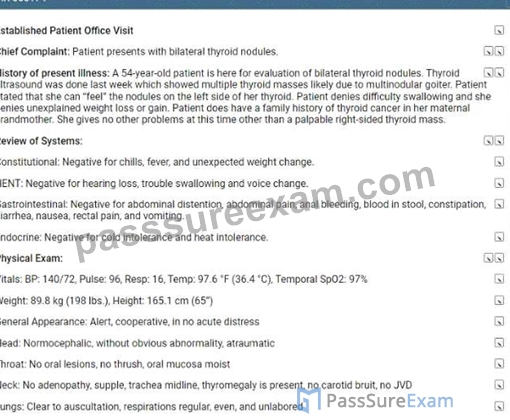
Refer to the supplemental information when answering this question:
View MR 065174
What E/M code is reported for this encounter?
- A. 0
- B. 1
- C. 2
- D. 3
Answer: C
Explanation:
To determine the correct E/M code, we need to consider the three key components: history, examination, and medical decision making (MDM).
* History:
* The documentation indicates an expanded problem-focused history. This is supported by the detailed history of present illness, including the patient's description of symptoms, family history, and review of systems with pertinent positives and negatives.
* Examination:
* The examination is also expanded problem-focused. The physician focused on the relevant systems (head, neck, throat) and documented specific findings related to the chief complaint (thyromegaly).
* Medical Decision Making:
* The MDM is straightforward. The physician is evaluating a new problem (bilateral thyroid nodules) with a low level of risk. Although further workup is planned, this alone doesn't automatically increase the MDM complexity.
Based on these components, 99213 is the most appropriate code.
Why other options are incorrect:
* 99212: Requires a problem-focused history and examination, which is less comprehensive than what was documented.
* 99214 and 99215: Require a higher level of MDM (low or moderate complexity) and/or a more detailed examination. The documentation doesn't support this level of service.
References:
* CPT Codes 99211-99215: Office or other outpatient visit for the evaluation and management of an established patient
* 1995 and 1997 Documentation Guidelines for Evaluation and Management Services: These guidelines provide detailed criteria for selecting the appropriate E/M code based on history, examination, and MDM.
* AAPC Coder's Desk Reference: This resource provides detailed information on coding guidelines and procedures.
NEW QUESTION # 117
A 55-year-old female patient is diagnosed with renal cell carcinoma. She is having a resection of the affected kidney, a portion of the ureter, and rib resection, open aproach. The procedure is complicated due to a prior surgical procedure performed on the same kidney.
What CPT coding is reported?
- A. 0
- B. 1
- C. 2
- D. 3
Answer: D
Explanation:
50236 - Radical nephrectomy with partial ureterectomy and rib resection, open approach Includes:
Kidney removal
Partial ureter removal
Rib resection
Correct for renal cell carcinoma
Increased complexity due to prior surgery does not change CPT code, but may support modifier -22 Why Other Options Are Incorrect:
50545 / 50548 - Laparoscopic/robotic nephrectomy
50225 - Simple nephrectomy (no ureter or rib resection)
NEW QUESTION # 118
(A patient presents to the OR for removal of asubcutaneous cardiac rhythm monitor system14 months after the device was implanted. What is the CPT code for this service?)
- A. 0
- B. 1
- C. 2
- D. 3
Answer: D
Explanation:
A "subcutaneous cardiac rhythm monitor" describes animplantable loop recorder(insertable cardiac monitor) placed under the skin for long-term rhythm surveillance. When the entire monitor system isremoved, CPT provides a specific removal code rather than using pacemaker/ICD removal codes.33286is the CPT code forremoval of an insertable cardiac monitor. The timing (14 months after implantation) supports that this is not an immediate post-op revision but a standard removal after monitoring is complete or the device is no longer needed. The distractors represent other cardiac device services:33241is removal of an implantable defibrillator pulse generator (not a loop recorder), and33272/33273relate to other cardiac device procedures rather than removal of an insertable monitor. CPC strategy: identify the device category-loop recorder
/insertable cardiac monitor-and match the service-removal-to the dedicated code. This avoids incorrectly reporting pacemaker/ICD codes, which are different devices with different procedural work and coding families.
NEW QUESTION # 119
The mediastinum is:
- A. A location in the chest, bounded by the sternum, diaphragm, and lungs
- B. A part of the lymphatic system
- C. Both the heart and lungs
- D. A small endocrine organ behind the heart
Answer: A
Explanation:
The mediastinum is an anatomical region located in the thoracic cavity. It is bounded by the sternum in front, the vertebral column at the back, and is situated between the lungs. It contains the heart, trachea, esophagus, thymus, and other structures, but it is not itself an organ. Therefore, the correct answer is that it is a location in the chest.
ICD-10-CM, Medical Anatomy and Physiology textbooks
NEW QUESTION # 120
The surgeon performs Roux-en-Y anastomosis of the extrahepatic biliary duct to the gastrointestinal tract on a
45-year-old patient.
What CPT code is reported?
- A. 0
- B. 1
- C. 2
- D. 3
Answer: D
Explanation:
The Roux-en-Y anastomosis of the extrahepatic biliary duct to the gastrointestinal tract is a specific surgical procedure that involves connecting the biliary duct to the gastrointestinal tract.
Procedure Description: Roux-en-Y anastomosis of the extrahepatic biliary duct involves creating a direct connection between the biliary duct and the gastrointestinal tract.
Procedure Specificity: The procedure is complex and involves extensive surgical technique and anastomosis.
Coding Decision:
CPT 47780 specifically describes the Roux-en-Y anastomosis of the extrahepatic biliary duct to the gastrointestinal tract.
AMA's CPT Professional Edition (current year).
CPT Assistant for detailed coding guidelines on biliary and gastrointestinal procedures.
NEW QUESTION # 121
A 67-year-old patient has osteomyelitis of the shoulder blade and is in surgery to remove the sequestered section of dead infected fragment bone from surrounding bone.
What CPT code is reported?
- A. 0
- B. 1
- C. 2
- D. 3
Answer: B
Explanation:
The key phrase is "remove the sequestered section of dead infected fragment bone", which is a sequestrectomy performed for osteomyelitis.
23172 describes sequestrectomy of the scapula (shoulder blade).Therefore, C is correct.
NEW QUESTION # 122
According to the ICD-10-CM coding guidelines, when coding hypertension with heart conditions classified to I50.- or I51.4-I51.7, I51.89, I51.9, what category should be used?
- A. Category I13, Hypertensive heart and chronic kidney disease
- B. Category I12, Hypertensive chronic kidney disease
- C. Category I10, Essential (primary) hypertension
- D. Category I11, Hypertensive heart disease
Answer: D
Explanation:
When hypertension and heart disease are documented together, a cause-and-effect relationship is presumed unless stated otherwise.
Category I11 (Hypertensive heart disease) is used.
Additional codes from I50.- (heart failure) are assigned if applicable.
This follows ICD-10-CM Official Coding Guidelines.
NEW QUESTION # 123
(A wheelchair-bound resident of a skilled nursing facility is seen in the physician's office. The physician's office makes arrangements with a social worker to take the patient back to the skilled nursing facility. What is the HCPCS Level II transportation service code?)
- A. A0130
- B. A0100
- C. A0120
- D. A0160
Answer: A
Explanation:
This scenario describesnon-emergencytransportation arranged for a patient who iswheelchair-bound, traveling between a physician's office and askilled nursing facility. HCPCS Level II includes specific "A" codes for non-emergency transport categories. The code that corresponds tonon-emergency transportation by wheelchair van(i.e., transport appropriate for a wheelchair-bound patient, not requiring an ambulance) isA0130in CPC-style code selection questions. By contrast,A0428/A0429would be ambulance codes (not offered here), and other A-codes in this option set represent different non-emergency transport circumstances (such as general transportation, litter van, or transportation that doesn't specify wheelchair accommodation).
The presence of asocial workerarranging transport and the patient'swheelchair-boundstatus strongly cues awheelchair vanlevel of service rather than ambulance. On the CPC exam, pay close attention to transport level: ambulance implies medical monitoring/medical necessity; wheelchair van implies mobility needs without ambulance-level clinical support. Therefore, the correct HCPCS Level II transportation code isA0130.
NEW QUESTION # 124
A patient who has colon adenocarcinoma undergoes a laparoscopic partial colectomy. The surgeon removes the proximal colon and terminal ileum and reconnects the cut ends of the distal ileum and remaining colon.
What procedure and diagnosis codes are reported?
- A. 44205, C18.9
- B. 44160, C18.2
- C. 44204, C18.2
- D. 44140, C18.9
Answer: A
NEW QUESTION # 125
......
Prepare for the Actual Certified Professional Coder CPC Exam Practice Materials Collection: https://passleader.passsureexam.com/CPC-pass4sure-exam-dumps.html