


Valid Microsoft Azure DP-300 Dumps Ensure Your Passing
DP-300 Dumps Real Exam Questions Test Engine Dumps Training
The DP-300 certification exam is ideal for database administrators, cloud database administrators, and database developers who want to enhance their knowledge and skills in managing and administering relational databases on Azure. Administering Relational Databases on Microsoft Azure certification exam is also suitable for individuals who are responsible for designing and implementing database solutions on Azure, and want to validate their skills and knowledge.
The Microsoft DP-300 exam covers a wide range of topics related to administering relational databases on the Azure platform, including designing and implementing databases, deploying and managing databases on Azure, securing and monitoring databases, implementing backup and recovery strategies, and optimizing database performance. Administering Relational Databases on Microsoft Azure certification exam is designed to test the ability of candidates to perform these tasks efficiently and effectively, making it a valuable credential for IT professionals who want to demonstrate their expertise in this area.
To prepare for the DP-300 certification exam, Microsoft offers a range of resources, including online training courses, practice exams, and study guides. These resources can help you familiarize yourself with the exam format, identify areas where you need to improve, and build your confidence before taking the exam.
NEW QUESTION # 90
You have SQL Server on an Azure virtual machine that contains a database named Db1.
You need to enable automatic tuning for Db1.
How should you complete the statements? To answer, select the appropriate answer in the answer area.
NOTE: Each correct selection is worth one point.
Answer:
Explanation:
Reference:
https://docs.microsoft.com/en-us/azure/azure-sql/database/automatic-tuning-enable
NEW QUESTION # 91
You receive numerous alerts from Azure Monitor for an Azure SQL database.
You need to reduce the number of alerts. You must only receive alerts if there is a significant change in usage patterns for an extended period.
Which two actions should you perform? Each correct answer presents part of the solution.
NOTE: Each correct selection is worth one point.
- A. Set the Alert logic threshold to Static
- B. Set the Alert logic threshold to Dynamic
- C. Set Force Plan to On
- D. Set Threshold Sensitivity to Low
- E. Set Threshold Sensitivity to High
Answer: B,D
Explanation:
Section: [none]
Explanation:
B: Dynamic Thresholds continuously learns the data of the metric series and tries to model it using a set of algorithms and methods. It detects patterns in the data such as seasonality (Hourly / Daily / Weekly), and is able to handle noisy metrics (such as machine CPU or memory) as well as metrics with low dispersion (such as availability and error rate).
D: Alert threshold sensitivity is a high-level concept that controls the amount of deviation from metric behavior required to trigger an alert.
Low - The thresholds will be loose with more distance from metric series pattern. An alert rule will only trigger on large deviations, resulting in fewer alerts.
Incorrect Answers:
A: High - The thresholds will be tight and close to the metric series pattern. An alert rule will be triggered on the smallest deviation, resulting in more alerts.
Reference:
https://docs.microsoft.com/en-us/azure/azure-monitor/platform/alerts-dynamic-thresholds
NEW QUESTION # 92
You have an instance of SQL Server on Azure Virtual Machines named VM1.
You need to use an Azure Automation runbook to initiate a SQL Server database backup on VM1.
How should you complete the command? To answer, select the appropriate options in the answer area.
NOTE: Each correct selection is worth one point.
Answer:
Explanation:
NEW QUESTION # 93
You need to design an analytical storage solution for the transactional dat a. The solution must meet the sales transaction dataset requirements.
What should you include in the solution? To answer, select the appropriate options in the answer area.
NOTE: Each correct selection is worth one point.
Answer:
Explanation:
Reference:
https://rajanieshkaushikk.com/2020/09/09/how-to-choose-right-data-distribution-strategy-for-azure-synapse/
NEW QUESTION # 94
HOTSPOT
You are evaluating the role assignments.
For each of the following statements, select Yes if the statement is true. Otherwise, select No.
NOTE: Each correct selection is worth one point.
Hot Area:
Answer:
Explanation:
Section: [none]
Explanation:
Box 1: Yes
DBAGroup1 is member of the Contributor role.
The Contributor role grants full access to manage all resources, but does not allow you to assign roles in Azure RBAC, manage assignments in Azure Blueprints, or share image galleries.
Box 2: No
Box 3: Yes
DBAGroup2 is member of the SQL DB Contributor role.
The SQL DB Contributor role lets you manage SQL databases, but not access to them. Also, you can't manage their security-related policies or their parent SQL servers. As a member of this role you can create and manage SQL databases.
Reference:
https://docs.microsoft.com/en-us/azure/role-based-access-control/built-in-roles Question Set 3
NEW QUESTION # 95
You have an Azure SQL database named DB 1 in the General Purpose service tier.
You need to monitor DB 1 by using SQL Insights.
What should you include in the solution? To answer, select the appropriate options in the answer area.
NOTE: Each correct selection is worth one point.
Answer:
Explanation:
Explanation
Box 1 = Azure Monitor Agent
Box 2 = An Azure SQL database
https://docs.microsoft.com/en-us/azure/azure-sql/database/sql-database-paas-overview?view=azuresql
NEW QUESTION # 96
You have an Azure SQL managed instance named SQLMI1 that has Resource Governor enabled and is used by two apps named App1 and App2.
You need to configure SQLMI1 to limit the CPU and memory resources that can be allocated to App1.
Which four actions should you perform in sequence? To answer, move the appropriate actions from the list of actions to the answer area and arrange them in the correct order.
Answer:
Explanation:
Explanation
Text, table Description automatically generated
Reference:
https://docs.microsoft.com/en-us/sql/relational-databases/resource-governor/resource-governor?view=sql-server-
https://docs.microsoft.com/en-us/sql/relational-databases/resource-governor/create-and-test-a-classifier-user-defi
NEW QUESTION # 97
You have an Azure SQL database named DB1. DB1 contains a table that has a column named Col1.
You need to encrypt the data in Col1.
Which four actions should you perform for DB1 in sequence? To answer, move the appropriate actions from the list of actions to the answer area and arrange them in the correct order.
Answer:
Explanation:
Explanation
Table Description automatically generated
Reference:
https://www.sqlshack.com/an-overview-of-the-column-level-sql-server-encryption/
NEW QUESTION # 98
You have a version-8.0 Azure Database for MySQL database.
You need to identify which database queries consume the most resources.
Which tool should you use?
- A. Alerts
- B. Metrics
- C. Query Performance Insight
- D. Query Store
Answer: D
Explanation:
Section: [none]
Explanation:
The Query Store feature in Azure Database for MySQL provides a way to track query performance over time.
Query Store simplifies performance troubleshooting by helping you quickly find the longest running and most
resource-intensive queries. Query Store automatically captures a history of queries and runtime statistics, and it
retains them for your review. It separates data by time windows so that you can see database usage patterns.
Data for all users, databases, and queries is stored in the mysql schema database in the Azure Database for
MySQL instance.
Reference:
https://docs.microsoft.com/en-us/azure/mysql/concepts-query-store
NEW QUESTION # 99
You are creating a managed data warehouse solution on Microsoft Azure.
You must use PolyBase to retrieve data from Azure Blob storage that resides in parquet format and load the data into a large table called FactSalesOrderDetails.
You need to configure Azure Synapse Analytics to receive the data.
Which four actions should you perform in sequence? To answer, move the appropriate actions from the list of actions to the answer area and arrange them in the correct order.
Answer:
Explanation:
1 - Create a master key on database.
2 - Create an external data source for Azure Blob storage.
3 - Create an external file format to map the parquet files.
4 - Create an external table FactSalesOrderDetails.
Reference:
https://docs.microsoft.com/en-us/sql/relational-databases/polybase/polybase-configure-azure-blob-storage
NEW QUESTION # 100
You have an Azure SQL database.
You discover that the plan cache is full of compiled plans that were used only once.
You run the select * from sys.database_scoped_configurationsTransact-SQL command and
receive the results shown in the following table.
You need relieve the memory pressure.
What should you configure?
- A. LEGACY_CARDINALITY_ESTIMATION
- B. QUERY_OPTIMIZER_HOTFIXES
- C. OPTIMIZE_FOR_AD_HOC_WORKLOADS
- D. ACCELERATED_PLAN_FORCING
Answer: C
Explanation:
Section: [none]
Explanation:
OPTIMIZE_FOR_AD_HOC_WORKLOADS = { ON | OFF }
Enables or disables a compiled plan stub to be stored in cache when a batch is compiled for the first time. The
default is OFF. Once the database scoped configuration OPTIMIZE_FOR_AD_HOC_WORKLOADS is enabled
for a database, a compiled plan stub will be stored in cache when a batch is compiled for the first time. Plan
stubs have a smaller memory footprint compared to the size of the full compiled plan.
Incorrect Answers:
A: LEGACY_CARDINALITY_ESTIMATION = { ON | OFF | PRIMARY }
Enables you to set the query optimizer cardinality estimation model to the SQL Server 2012 and earlier version
independent of the compatibility level of the database. The default is OFF, which sets the query optimizer
cardinality estimation model based on the compatibility level of the database.
B: QUERY_OPTIMIZER_HOTFIXES = { ON | OFF | PRIMARY }
Enables or disables query optimization hotfixes regardless of the compatibility level of the database. The default
is OFF, which disables query optimization hotfixes that were released after the highest available compatibility
level was introduced for a specific version (post-RTM).
Reference:
https://docs.microsoft.com/en-us/sql/t-sql/statements/alter-database-scoped-configuration-transact-sql
NEW QUESTION # 101
You configure backup for an Azure SQL database as shown in the following exhibit.
Use the drop-down menus to select the answer choice the completes each statement based on the information presented in the graphic.
NOTE: Each correct selection is worth one point.
Answer:
Explanation:
Explanation
NEW QUESTION # 102
You are building a database in an Azure Synapse Analytics serverless SQL pool.
You have data stored in Parquet files in an Azure Data Lake Storage Gen2 container.
Records are structured as shown in the following sample.
The records contain two applicants at most.
You need to build a table that includes only the address fields.
How should you complete the Transact-SQL statement? To answer, select the appropriate options in the answer area.
NOTE: Each correct selection is worth one point.
Answer:
Explanation:
Reference:
https://docs.microsoft.com/en-us/azure/synapse-analytics/sql/develop-tables-external-tables
NEW QUESTION # 103
You have an Azure subscription that contains an Azure SQL managed instance, a database named db1, and an Azure web app named Appl. Appl uses db1.
You need to enable Resource Governor for a App1. The solution must meet the following requirements:
App1 must be able to consume all available CPU resources.
App1 must have at least half of the available CPU resources always available.
Which three actions should you perform in sequence? To answer. move the appropriate actions from the list of actions to the answer area and arrange them in the correct order NOTE: More than one order of answer choices is correct. You will receive credit for any of the correct orders you select.
Answer:
Explanation:
1 - Create a resource pool that has the following configurations...
2 - Create a workload group.
3 - Create a classifier function in the master database.
NEW QUESTION # 104
You have an Azure SQL managed instance.
You need to restore a database named DB1 by using Transact-SQL.
Which command should you run? To answer, select the appropriate options in the answer area.
NOTE: Each correct selection is worth one point.
Answer:
Explanation:
NEW QUESTION # 105
You have two instances of SQL Server on Azure virtual Machines named VM1 and VM2. VM1 hosts a database named dbl.
You plan to create a database availability group (DAG) for dbl. The solution must use certificate authentication between VM1 and VM2.
You need to configure authentication for the outbound connections of VM1.
Which three actions should you perform in sequence? To answer, move the appropriate actions from the list of actions to the answer area and arrange them in the correct order.
Answer:
Explanation:
1 - From the master database, run CREATE MASTER KEY...
2 - From the master databse, run CREATE CERTIFICATE.
3 - From db1, run CREATE ENDPOINT.
NEW QUESTION # 106
You configure backups for an Azure SQL database as shown in the following exhibit.
Use the drop-down menus to select the answer choice that completes each statement based on the information presented in the graphic.
NOTE: Each correct selection is worth one point.
Answer:
Explanation:
NEW QUESTION # 107
You have SQL Server on an Azure virtual machine that contains a database named DB1. DB1 is 30 TB and has a 1-GB daily rate of change.
You back up the database by using a Microsoft SQL Server Agent job that runs Transact-SQL commands. You perform a weekly full backup on Sunday, daily differential backups at 01:00, and transaction log backups every five minutes.
The database fails on Wednesday at 10:00.
Which three backups should you restore in sequence? To answer, move the appropriate backups from the list of backups to the answer area and arrange them in the correct order.
Answer:
Explanation:
1 - full backup
2 - Wednesday differential backup
3 - Wednesday log backups
NEW QUESTION # 108
You have SQL Server on an Azure virtual machine.
You review the query plan shown in the following exhibit.
For each of the following statements, select yes if the statement is true. Otherwise, select no.
NOTE: Each correct selection is worth one point.
Answer:
Explanation:
Reference:
https://docs.microsoft.com/en-us/sql/relational-databases/performance/monitoring-performance-by-using-the-query-store
NEW QUESTION # 109
You have SQL Server on an Azure virtual machine that contains a database named Db1.
You need to enable automatic tuning for Db1.
How should you complete the statements? To answer, select the appropriate answer in the answer area.
NOTE: Each correct selection is worth one point.
Answer:
Explanation:
Explanation:
Box 1: SET AUTOMATIC_TUNING = AUTO
To enable automatic tuning on a single database via T-SQL, connect to the database and execute the following query:
ALTER DATABASE current SET AUTOMATIC_TUNING = AUTO
Setting automatic tuning to AUTO will apply Azure Defaults.
Box 2: SET AUTOMATIC_TUNING (FORCE_LAST_GOOD_PLAN = ON)
To configure individual automatic tuning options via T-SQL, connect to the database and execute the query such as this one:
ALTER DATABASE current SET AUTOMATIC_TUNING (FORCE_LAST_GOOD_PLAN = ON) Setting the individual tuning option to ON will override any setting that database inherited and enable the tuning option. Setting it to OFF will also override any setting that database inherited and disable the tuning option.
Reference:
https://docs.microsoft.com/en-us/azure/azure-sql/database/automatic-tuning-enable
NEW QUESTION # 110
You are provisioning an Azure SQL database in the Azure portal as shown in the following exhibit.
Use the drop-down menus to select the answer choice that completes each statement based on the information presented in the graphic.
NOTE:Each correct selection is worth one point.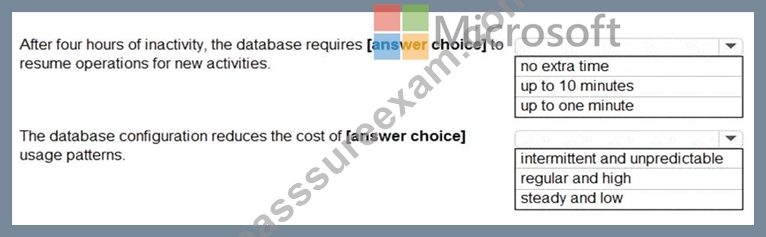
Answer:
Explanation:
Explanation
Graphical user interface, text, application, email Description automatically generated
Reference:
https://docs.microsoft.com/en-us/azure/azure-sql/database/serverless-tier-overview
NEW QUESTION # 111
You have the following Azure Resource Manager template.
For each of the following statements, select Yes if the statement is true. Otherwise, select No.
NOTE: Each correct selection is worth one point.
Answer:
Explanation:
Explanation
A screenshot of a computer Description automatically generated with low confidence
Reference:
https://docs.microsoft.com/en-us/azure/azure-sql/database/purchasing-models
https://docs.microsoft.com/en-us/azure/azure-sql/database/single-database-create-arm-template-quickstart
NEW QUESTION # 112
......
Microsoft DP-300: Selling Microsoft Azure Products and Solutions: https://passleader.passsureexam.com/DP-300-pass4sure-exam-dumps.html